
Species Needs
Closing the Welfare Gap
Every species has evolved to function within a specific ecological and behavioural context that shapes its needs in captivity.
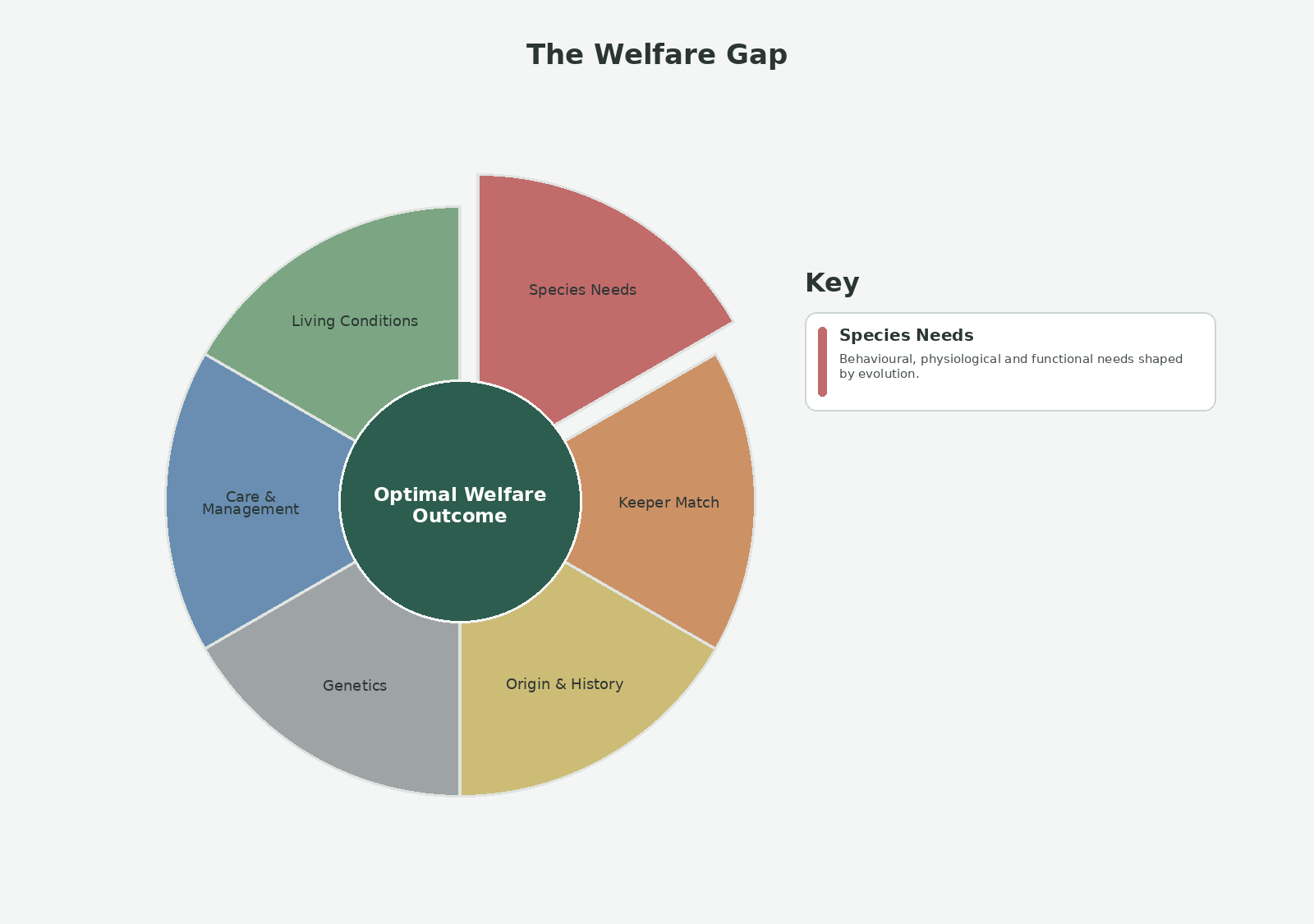
These species-specific needs shape how animals feed, move, thermoregulate, communicate, reproduce, avoid danger and interact with their environment.
Captive welfare depends on understanding these functional needs and providing opportunities for the animal to express natural behaviour through appropriate levels of choice, agency and challenge.
For many species, welfare problems arise not from deliberate neglect, but from an incomplete understanding of how the animal naturally lives and functions.
Understanding species needs within the Welfare Gap framework means considering:
behavioural needs,
physiological requirements,
natural activity patterns,
cognitive and sensory abilities,
social structure and communication,
environmental interactions,
and how the species has evolved to survive and function in the wild.
Species differ greatly in complexity.
Some animals can adapt relatively well to captive environments, while others may struggle to achieve positive welfare outcomes even under experienced care.
The more specialised or complex the species, the smaller the margin for error becomes.
Species Needs interacts closely with the other welfare pillars.
Exploring the Welfare Pillars
Each pillar influences the welfare outcome of the individual animal and interacts with the others to shape overall welfare.
Understanding these interactions is essential for closing the welfare gap.
Return to From Niche to Need to explore the taxon routes, practical questions and seven interconnected biological perspectives.