
Living Conditions
Closing the Welfare Gap
The physical environment has a major influence on welfare outcomes, because animals kept in captivity are unable to leave unsuitable conditions.
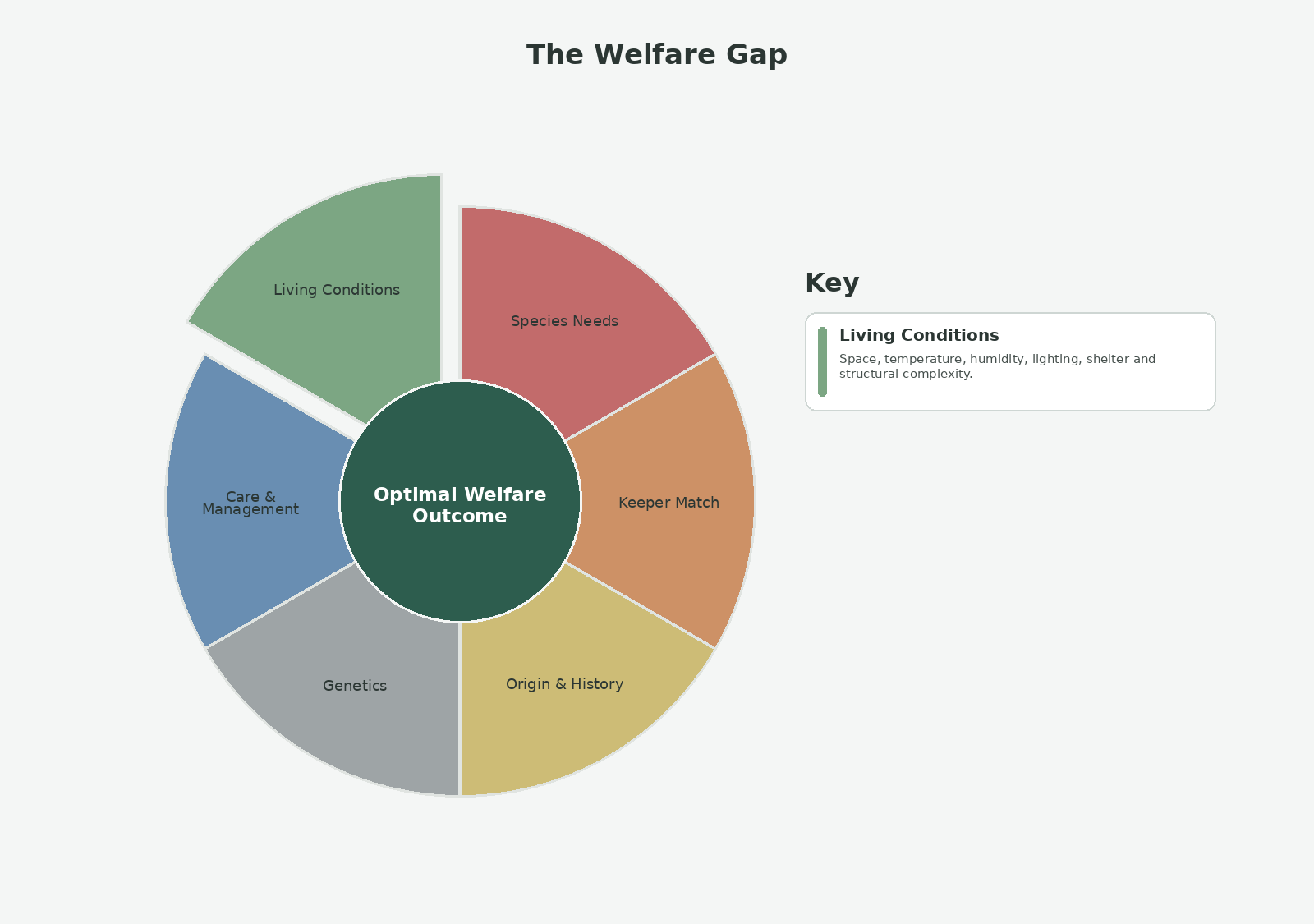
Living conditions affect an animal’s ability to regulate temperature, rest, move, hide, explore, forage and behave naturally. The structure and complexity of the environment can either support or restrict welfare.
Captive environments should not simply prevent suffering. They should provide conditions that allow the animal to function well.
Understanding living conditions within the Welfare Gap framework means considering:
available space,
enclosure structure and complexity,
temperature and humidity gradients,
lighting and photoperiod,
shelter and security,
water availability,
substrate and environmental enrichment,
and opportunities for choice, control and natural behaviour.
Animals experience environments differently depending on their biology and behaviour.
An enclosure that appears large or well equipped to people may still fail to meet the functional needs of the species living within it.
Positive welfare depends not only on the presence of husbandry equipment, but on whether the environment allows the animal to use it in biologically meaningful ways.
Living Conditions interacts closely with the other welfare pillars.
Exploring the Welfare Pillars
Each pillar influences the welfare outcome of the individual animal and interacts with the others to shape overall welfare.
Understanding these interactions is essential for closing the welfare gap.
Return to From Niche to Need to explore the taxon routes, practical questions and seven interconnected biological perspectives.