
Origin & History
Closing the Welfare Gap
An animal’s welfare is shaped not only by its current environment, but also by its past.
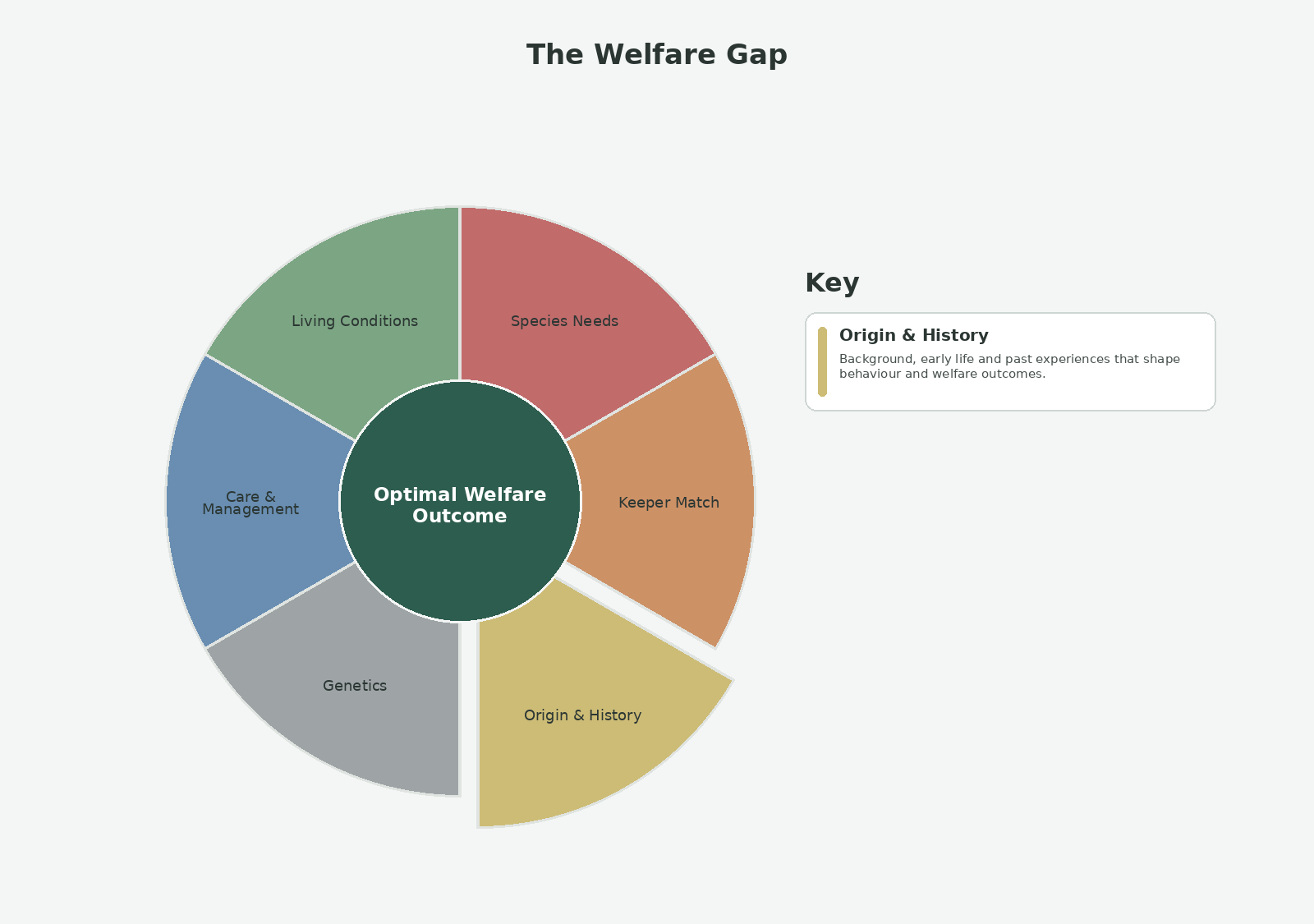
Origin and history influence behaviour, stress responses, health and the animal’s ability to adapt to captivity. Early life experiences can have lasting effects throughout life.
Animals may differ significantly depending on whether they are:
wild-caught,
captive-bred,
commercially bred,
rescued,
rehomed,
or sourced through poorly regulated trade systems.
Early nutrition, social experiences, transport, handling, maternal care and exposure to stress can all influence long-term welfare outcomes.
Understanding origin and history within the Welfare Gap framework means considering:
background and source,
early developmental experiences,
previous husbandry conditions,
transport and trade impacts,
socialisation and behavioural development,
and cumulative stress or trauma over time.
Two animals of the same species may therefore have very different welfare needs and capacities to cope in captivity.
Without understanding origin and history, welfare problems may be misunderstood or overlooked.
Origin & History interacts closely with the other welfare pillars.
Exploring the Welfare Pillars
Each pillar influences the welfare outcome of the individual animal and interacts with the others to shape overall welfare.
Understanding these interactions is essential for closing the welfare gap.
Return to From Niche to Need to explore the taxon routes, practical questions and seven interconnected biological perspectives.