
Keeper Match
Closing the Welfare Gap
Good welfare depends not only on the species, but also on the person responsible for its care.
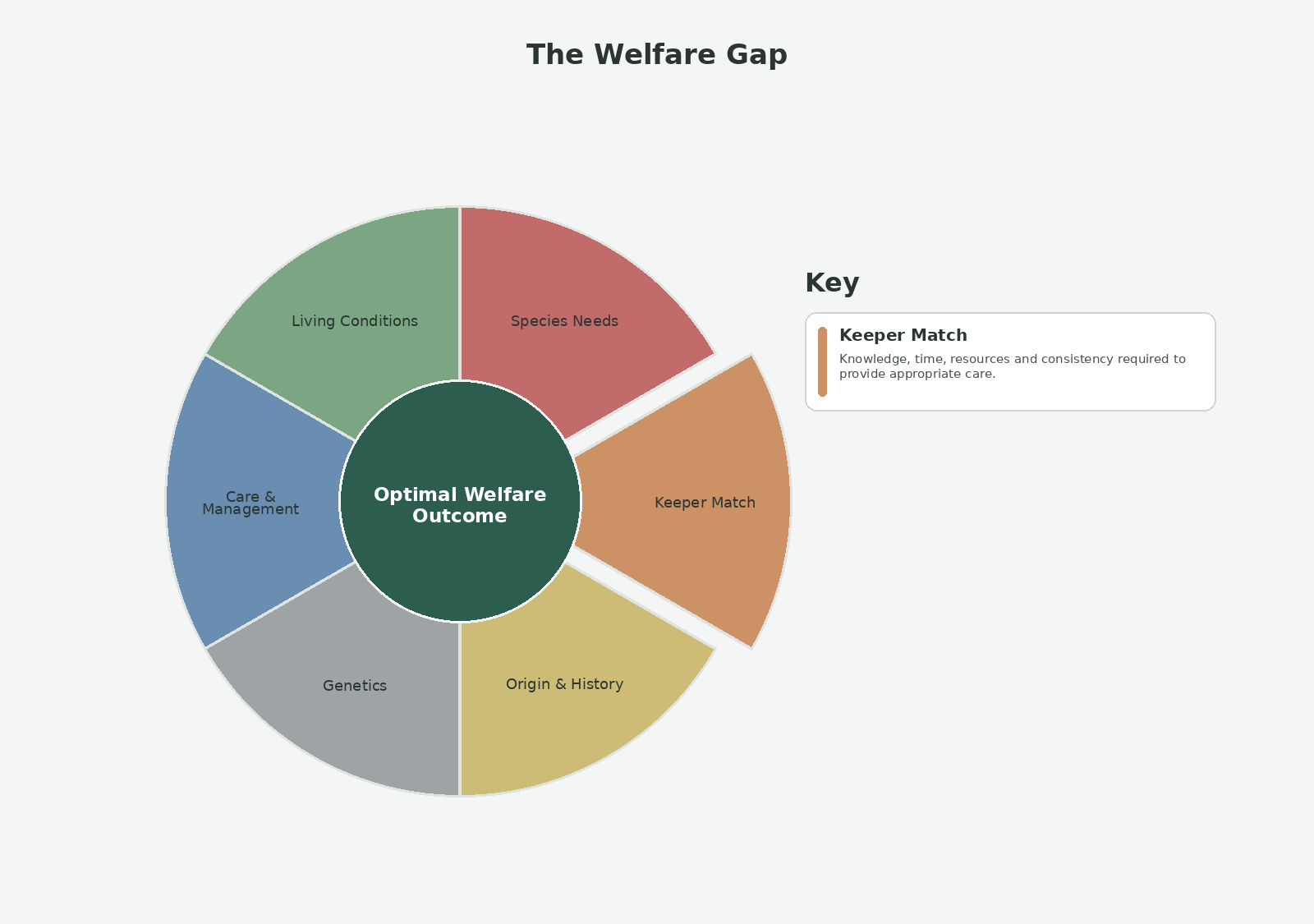
Different species require different levels of knowledge, time, consistency, resources and practical capability. A mismatch between the keeper and the animal can increase the Welfare Gap — even where intentions are good.
Some species require highly specialised environments, complex diets, advanced behavioural understanding or long-term commitment over many years. Others may be more adaptable or resilient in captivity.
Understanding keeper match within the Welfare Gap framework means considering:
species-specific knowledge,
practical husbandry capability,
available time and consistency of care,
financial and space requirements,
access to appropriate equipment and veterinary support,
and the keeper’s ability to adapt care as the animal’s needs change over time.
Keeper match is not about blame or judgement.
It is about recognising that positive welfare outcomes depend on whether the needs of the species can realistically and consistently be met in practice.
Even highly motivated keepers may struggle if the complexity of the species exceeds what can realistically be provided.
Keeper Match interacts closely with the other welfare pillars.
Each pillar influences the welfare outcome of the individual animal and interacts with the others to shape overall welfare.
Understanding these interactions is essential for closing the welfare gap.
Exploring the Welfare Pillars
Return to From Niche to Need to explore the taxon routes, practical questions and seven interconnected biological perspectives.