
EVOLVE
Rethinking Husbandry Education
Starting with the species.
Understanding the individual.
Empowering those responsible for their care.
What if we taught animal husbandry by starting with WHY, rather than WHAT?
Traditional husbandry education often begins with what we should provide: enclosure dimensions, temperature ranges, lighting, humidity, food, substrate and enrichment.
But what if we started somewhere different?
Every species has an evolutionary history that has influenced its biology, physiology, sensory capabilities and behaviour. These adaptations influence how animals experience their surroundings, regulate their bodies, respond to challenges and interact with other animals and their environment.
And that biology does not disappear when an animal enters captivity.
Understanding WHY an animal needs particular conditions and opportunities changes how we think about WHAT we provide.
Rather than simply maintaining an enclosure at prescribed conditions, we can consider how to create an environment in which the animal has opportunities to regulate its own body, access suitable microclimates, exercise behavioural capabilities, male meaningful choices and exert greater control over its daily life.
The keeper becomes more than someone following care instructions. They become an informed decision-maker, able to understand the reasoning behind husbandry recommendations, recognise individual differences, observe how the animal responds and adapt care as knowledge develops.
EVOLVE is an educational approach developed by Species First to put this understanding at the heart of husbandry education.
It does not replace evidence-based species-specific husbandry guidance. Instead, it empowers keepers to understand the reasoning behind the guidance, apply it thoughtfully, observe the animal in their care and evaluate whether the opportunities provided are meeting the individual animal’s needs.
Putting EVOLVE into practice
Understanding WHY changes how we approach WHAT we provide.
Consider thermoregulation in reptiles.
Traditional husbandry guidance may specify recommended temperatures, heating equipment and enclosure conditions.
But understanding the species' evolutionary history, physiology and ecology helps us appreciate why access to different thermal conditions matters.
Reptiles vary considerably in how they regulate their body temperatures. Their activity patterns, preferred microhabitats, behavioural adaptations and physiological requirements influence how they use the thermal opportunities available to them.
Rather than simply providing a prescribed temperature, we can consider how enclosure design enables an animal to move between suitable microclimates, access warmth or cooler refuges, and regulate its body temperature through behavioural choice.
The keeper's responsibility is to establish and maintain appropriate conditions, while providing the animal with meaningful opportunities to choose between them.
Observation then becomes essential. How does the individual use the available space and thermal gradients? Can it access suitable conditions while remaining sheltered or secure? Are adjustments needed?
The focus moves from simply providing the recommended conditions to understanding why they matter, enabling the animal to use them and evaluating whether they are meeting its needs.
Rethinking how we teach animal care
Husbandry education has an important role in helping people develop the knowledge, practical skills and confidence needed to care for animals throughout their lives.
EVOLVE encourages an approach that goes beyond learning husbandry requirements to understanding the biological reasons behind them.
This means helping learners to:
Understand the species: Explore its evolutionary history, ecology, biology and behavioural capabilities.
Design for opportunities: Consider how environments can provide meaningful choice, agency and access to the conditions and resources the animal needs.
Understand the individual: Recognise differences in genetics, origin, experiences, health, behaviour and preferences.
Keep learning and adapting: Observe welfare outcomes, question assumptions and respond to developing scientific and practical knowledge.
These principles can support education in colleges, veterinary settings, zoos, aquariums, rescue organisations and the wider animal-keeping community.
They also encourage a more preventative approach to animal welfare, helping keepers recognise and address potential problems before they develop into more serious health or welfare concerns.
Effective husbandry education should not simply teach people how to care for animals.
It should empower them to understand the animals in their care.
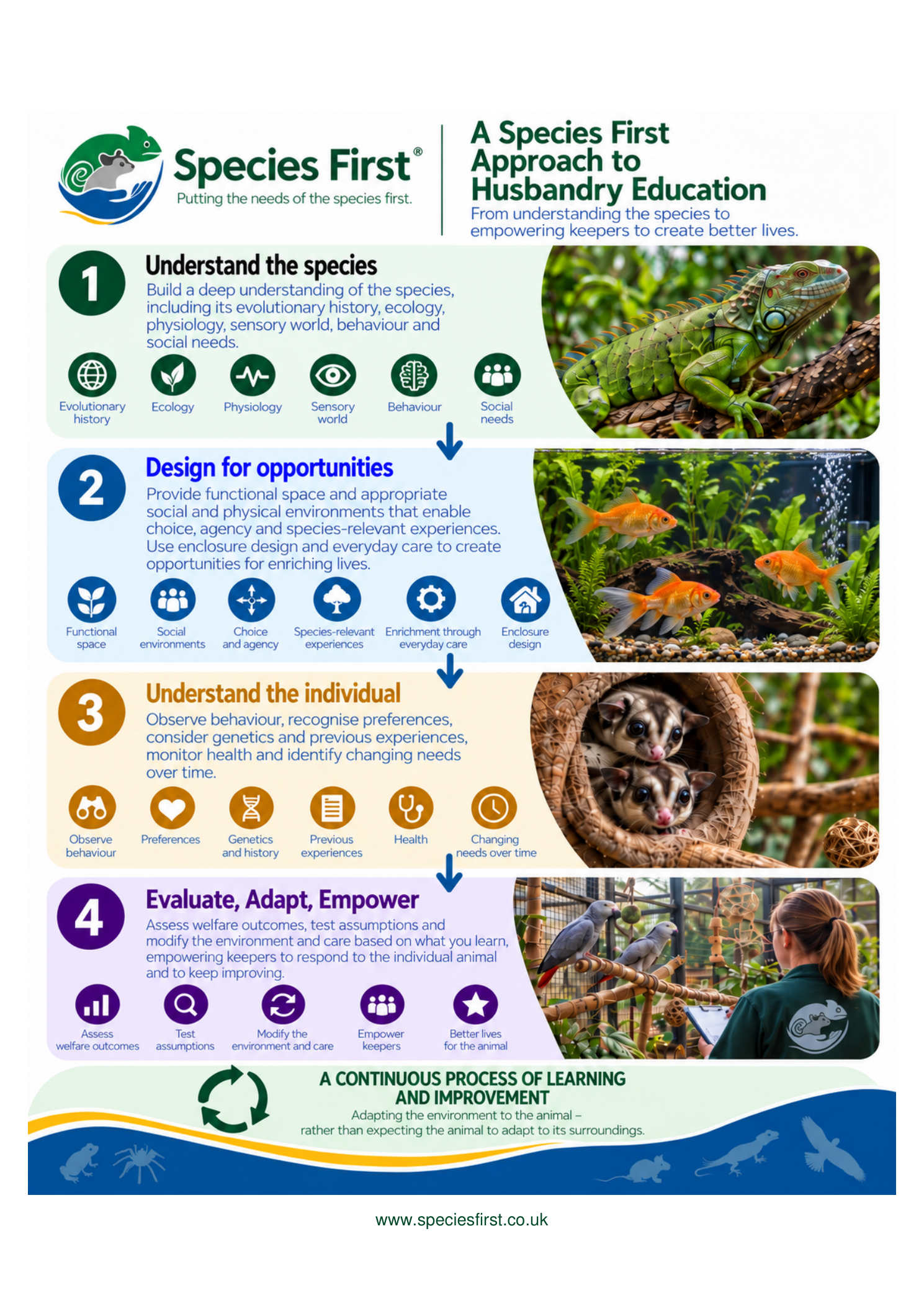
Rethinking husbandry education: Four connected principles for understanding species, designing meaningful opportunities, recognising individuals and continually improving care.
Connecting understanding with welfare outcomes
EVOLVE is part of a wider Species First approach that connects scientific understanding, practical husbandry and the welfare outcomes experienced by individual animals.
From Niche to Need
Understanding the species
Explore how evolutionary history, ecology, sensory capabilities, physiology and behaviour help explain why species need access to particular conditions and opportunities in captivity.
Closing the Welfare Gap
Identifying opportunities for improvement
Explore how genetics, origin and history, keeper compatibility, species needs, living conditions, and care and management interact to influence animal welfare outcomes.
Keeper Match
Understanding the responsibilities of care
Consider whether the knowledge, expectations, resources and circumstances of those responsible for an animal are compatible with meeting its needs throughout its life.
Together, these approaches encourage us to look beyond minimum husbandry provisions and consider what is needed to support positive welfare outcomes for each individual animal.
Learning together
Improving animal welfare requires knowledge, experience, curiosity and collaboration.
Scientific research continues to reveal new insights into animal biology, behaviour, cognition and welfare. Equally important are the observations and practical experiences of those who work with and care for animals every day.
Species First recognises the value of bringing these different perspectives together.
EVOLVE is intended to support educators, students, keepers, breeders, retailers, veterinary professionals, researchers, animal welfare organisations and zoological institutions in developing a deeper understanding of animals and their needs.
As this approach develops, Species First welcomes opportunities to collaborate on educational resources, review existing husbandry guidance, explore practical applications and evaluate how improved understanding can translate into better welfare outcomes.
Because good husbandry education should do more than tell us what animals need. It should help us understand why, empower us to respond and encourage us to keep learning.