
From Niche to Need
Explore how evolutionary history helps us understand what animals need from captive care.
Every species brings an evolutionary history into captivity.
Different species of animals differ profoundly in how they perceive their surroundings, regulate their bodies, move through space, obtain and process food, communicate, reproduce, interact with other animals and respond to risk.
Those differences did not arise because animals were designed for particular environments. They developed through evolutionary processes acting across many generations.
Moving an animal into a human-controlled environment changes its surroundings. It does not remove the biology it brings with it. Domestication, selective breeding over generations can alter aspects of their biology, but evolutionary history remains an essential starting point for understanding what an animal may need.
From Niche to Need reviews what that biology means in captivity.
What does the animal want and what does it not want?
What does the animal need opportunities to do?
What information does it need to perceive?
What must it be able to regulate, choose, avoid or control?
And ultimately:
What is the individual animal actually experiencing?
Same fundamental challenges. Different biological solutions.
Select a taxon (animal group) card below as a doorway into From Niche to Need.
Explore how different species live, the questions their care raises and how ecology, anatomy, physiology, sensation and behaviour interact within the animal and influence its needs and experience in captivity.
Each card includes a From Niche to Need poster using one species as a worked example. No single species represents the whole taxonomic group.
Follow the different taxon routes to compare species, explore similarities and differences within and between each group, start with common questions about captivity and then look more closely at the biology behind their needs.
Alternatively, delve straight into the animal biology by exploring below the taxon cards.
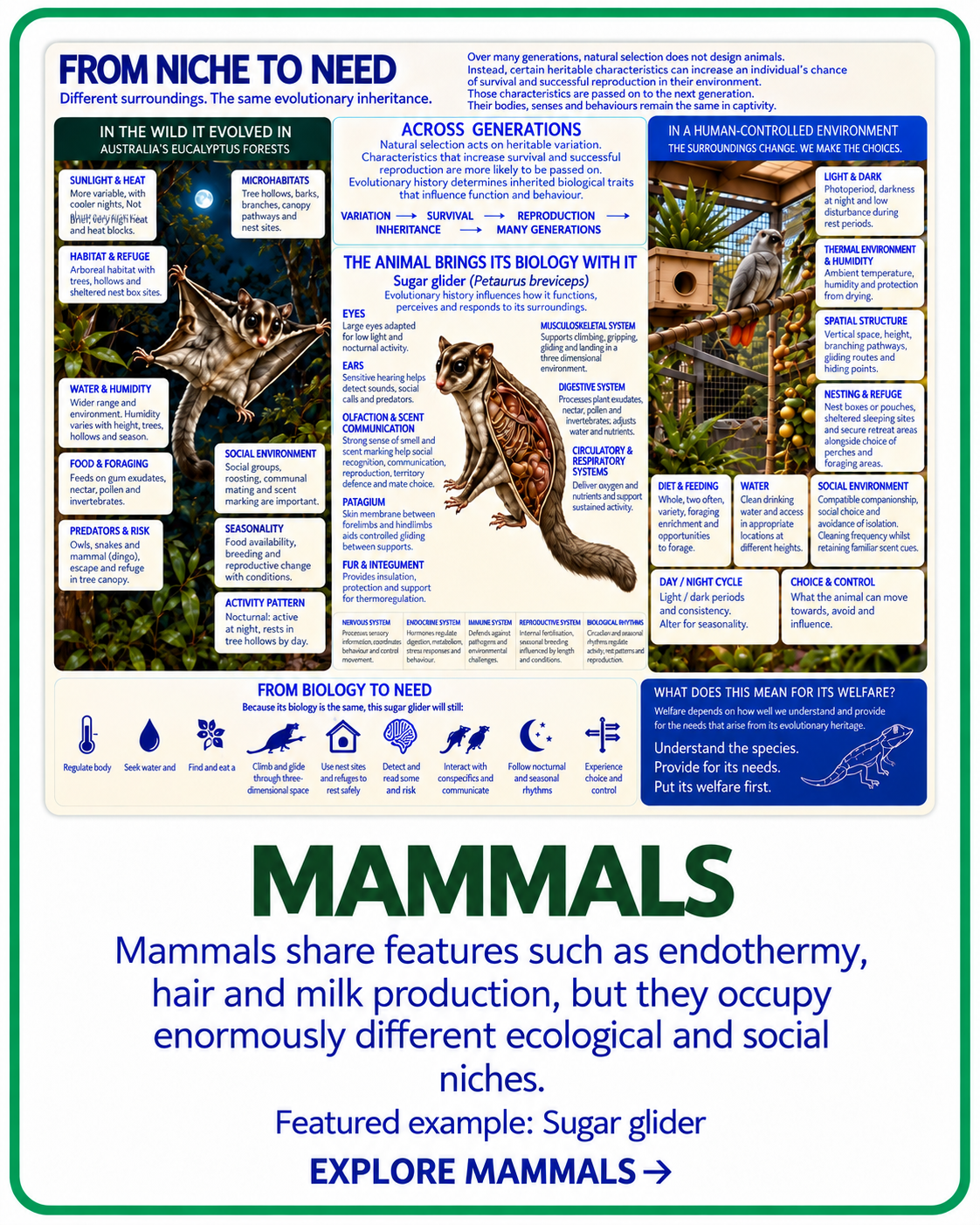
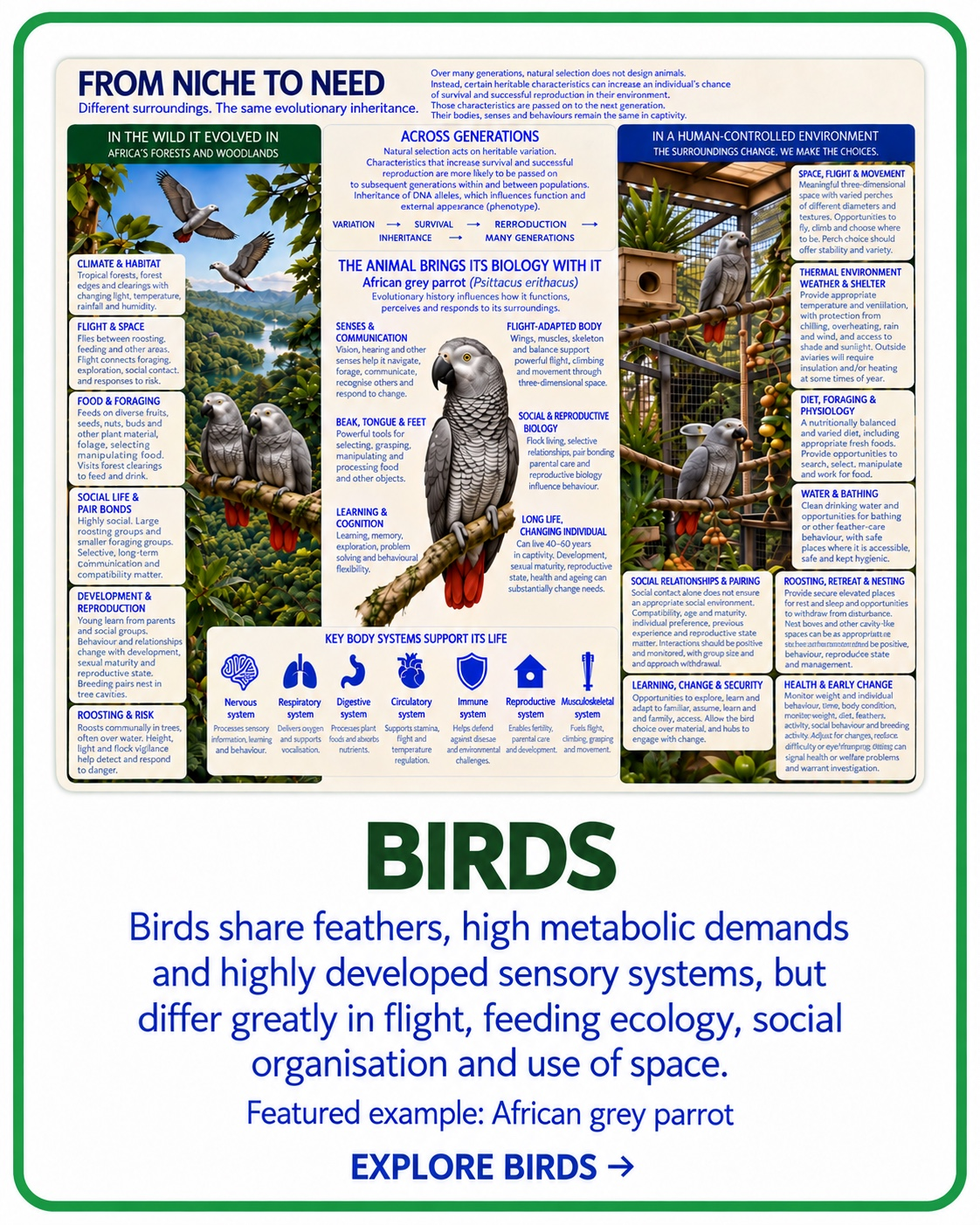
The taxonomic group is only the beginning.
Within each route, compare species, start with familiar questions about captive care and then follow the biology as far as you want to go.
Species is the starting point.
The individual animal is where welfare is experienced.
Health is fundamental to welfare, but welfare is much more than health.
Health affects how an animal experiences and responds to its surroundings. Welfare also depends on what the animal seeks, avoids, values and chooses, and on the positive and negative experiences that result.
To explore the biology behind the needs
The taxon routes begin with particular animals.
The seven perspectives below provide another way into From Niche to Need by looking at biological processes that operate across taxa.
What does an animal bring to captivity?
Explore From Niche to Need through seven interconnected biological perspectives.
These perspectives are separated here to help us examine the biology.
In the living animal they do not operate independently.
Sensory information influences movement and risk assessment; nutrition influences physiology and cognition; social conditions influence endocrine state and behaviour; and opportunities for choice depend on what the animal can perceive and what actions its body and surroundings make possible.
1. Senses & Perception
How does the animal detect and interpret its surroundings?
Vision, hearing, olfaction, chemoreception, touch and specialised sensory systems can produce very different perceptual worlds. Some species may detect wavelengths, sounds, vibrations or chemical traces that humans cannot perceive, while others may depend on sensory information that is easily disrupted by artificial light, unfamiliar odours, background noise, reflective surfaces or constant human activity.
The location, intensity, timing and predictability of sensory information can all matter. A cue may help an animal find food, recognise a mate, identify a familiar individual, navigate through space or detect danger. The same environment may therefore be stimulating and informative for one species but confusing, impoverished or threatening for another.
Sensory biology also influences how animals learn and make decisions. What appears to be an empty enclosure may contain a complex chemical, acoustic or visual landscape, while a seemingly attractive feature may be difficult or impossible for the animal to perceive in the way people intend.
2. Body, Movement & Space
What does the animal’s anatomy allow and motivate it to do?
Body form, integument, limbs, locomotor systems and spatial ecology influence how animals climb, dig, swim, fly, glide, hide and move through their surroundings. A body adapted for burrowing may require opportunities to push through, excavate and occupy enclosed spaces, while a body adapted for climbing or gliding may depend on height, stable supports, launch points and routes through three-dimensional space.
Movement is not only exercise. It may be part of exploration, escape, foraging, territorial behaviour, courtship, social interaction, thermoregulation or access to preferred resources. The shape, texture, spacing and arrangement of environmental features can determine whether an animal can use its body safely and effectively.
Restricted space can therefore affect more than distance travelled. It may prevent normal postures, limit choice, increase collision risk, make important resources inaccessible or remove the ability to move away from disturbance. Conversely, a larger space is not automatically more functional if it lacks usable structure, refuge, traction or navigable routes.
3. Internal Regulation & Physiology
How does the animal maintain its internal environment?
Thermoregulation, metabolism, endocrine activity, hydration, immune function and other physiological systems influence what environmental conditions are biologically important. Animals may regulate body temperature through external heat sources, behavioural movement, changes in blood flow, insulation, evaporative cooling or metabolic heat production, and these strategies place very different demands on captive environments.
Temperature is only one part of the picture. Humidity, airflow, access to water, substrate, light, shelter and the timing of environmental change can influence hydration, skin or respiratory function, digestion, activity and sleep. Physiological systems also respond to stressors, illness, injury, reproductive state and energetic demands, so the same conditions may not be equally suitable throughout an animal’s life.
Many important processes are invisible until they fail. An animal may appear to be coping while its energy balance, hydration, immune function, endocrine system or thermoregulatory options are being challenged. Providing appropriate gradients, refuges and opportunities for behavioural regulation can allow the animal to participate in maintaining its own internal stability rather than relying on a single fixed condition.
4. Food, Foraging & Digestion
Food is more than nutrition.
Species differ in what they eat, how they locate, select and obtain food, when they feed, and how their diets change across habitats, seasons and stages of life. Nutrient requirements may vary with age, growth, illness, recovery, reproductive condition and the production or care of young.
An animal’s anatomy also shapes how it handles food. Teeth, jaws, beaks, tongues, claws and other structures may tear, crush, grind, pierce or swallow food whole, while some animals chew extensively and others do not. Digestive systems can vary enormously with diet, from relatively simple guts to specialised chambers and microbial communities that allow particular foods to be broken down and nutrients absorbed.
Some animals ruminate, regurgitating and rechewing partially digested food. Others process indigestible material in different ways, including regurgitating compacted remains as pellets. These differences influence not only what nutrients an animal needs, but also how food should be presented and what opportunities to search, manipulate, process, consume and eliminate food may matter to welfare.
5. Social & Reproductive Biology
How does the animal interact with others of its species?
Social organisation can range from solitary living to stable pairs, family groups, colonies or fluid associations that change with season, resources and reproductive condition. The presence, absence, identity and behaviour of other animals can therefore influence safety, access to resources, communication, stress, learning and opportunities to perform species-typical behaviour.
Communication may involve sound, posture, movement, touch, facial or body markings, vibration and scent. Social information can be carried through the environment even when animals are out of sight, making separation, proximity, odour control and enclosure design biologically significant. A social arrangement that appears calm may still prevent an individual from withdrawing, accessing resources or avoiding persistent attention.
Reproduction also involves more than mating. Hormonal cycles, courtship, mate choice, nesting, gestation, egg laying, birth, parental care, offspring development and separation can all create changing needs. Age, sex, reproductive history and individual compatibility may alter how animals use space and respond to companions, while captive conditions can influence whether reproductive behaviours are possible, disrupted or expressed in inappropriate contexts.
6. Risk, Refuge & Response
How does the animal recognise and respond to possible danger?
Predator detection, vigilance, concealment, defensive behaviour, flight, refuge seeking and physiological threat responses remain relevant even when the original predators are absent. Animals may be sensitive to movement above them, sudden approach, direct gaze, unfamiliar sounds, vibrations, odours or the loss of visual cover, depending on the risks encountered during their evolutionary history.
A refuge is not simply an object placed in an enclosure. Its position, entrance size, internal structure, visibility, temperature, accessibility and relationship to food, water and social companions can determine whether it functions as a usable place of safety. Some animals need to hide completely, while others need protected observation points from which they can monitor their surroundings without being exposed.
Repeated inability to escape, conceal themselves or control proximity to disturbance can keep threat systems active even when no physical attack occurs. This may affect vigilance, sleep, feeding, exploration, social behaviour and physiological health. Providing choice between exposed and protected areas can help an animal assess risk and regulate its own responses rather than forcing constant exposure or complete isolation.
7. Time, Motivation, Choice & Control
When does the animal become active, and what is it motivated to do?
Animals live within biological time. Daily rhythms can influence sleep, activity, feeding, thermoregulation, hormone release, communication and social interaction, while seasonal changes may affect migration, moulting, hibernation, torpor, reproduction, coat or plumage, appetite and habitat use.
Motivation is also dynamic. An animal may be driven to search, explore, manipulate, climb, dig, hunt, hide, interact, court, nest or rest depending on its internal state and the opportunities available. These motivations are shaped by hunger, reproductive hormones, previous experience, novelty, uncertainty, reward and the changing value of resources.
Captive routines can support or disrupt these systems. Predictability may help an animal anticipate important events, but an environment that is completely fixed may remove opportunities to make choices or respond to meaningful change. Choice and control can include selecting where to rest, when to approach, which route to take, whether to interact, how closely to remain to others and when to withdraw.
The surroundings change; the biology doesn’t disappear
Once an animal is in captivity, people assume control over many of the variables with which the species evolved to interact.
This creates both an opportunity and a responsibility.
Captivity can protect animals from predation, food shortage, climatic extremes, injury and disease.
But good welfare requires more than removing negative experiences.
It requires understanding how the animal’s inherited biology influences what it perceives, what its body requires, what it is motivated to do or avoid and what opportunities matter to it.
FROM NICHE TO NEED
NICHE
↓
EVOLUTIONARY PROCESSES
↓
INHERITED BIOLOGY
↓
PERCEPTION - PHYSIOLOGY - MOTIVATION - BEHAVIOUR
↓
BIOLOGICAL AND BEHAVIOURAL NEEDS
↓
CAPTIVE PROVISION
↓
THE INDIVIDUAL ANIMAL’S EXPERIENCE
↓
WELFARE OUTCOMES
From need to welfare
Understanding where needs originate is only the first step.
The next question is whether captive environments, husbandry practices and human decision-making allow those needs to be met.
A developing Species First resource
From Niche to Need will continue to expand through the six taxon routes, practical questions about keeping animals, the seven interconnected biological perspectives, further species examples and deeper exploration of the relationships between evolutionary history, ecology, sensory biology, anatomy, physiology, behaviour and welfare in captivity.
Every species brings a unique evolutionary history into captivity.
Species is the starting point. The individual animal is where welfare is experienced.
Understanding the animal helps us understand what its captive environment and care need to provide.